
A framework showing how to write distinctively using AI tools.

Generative AI has become deeply embedded in the production of written communication.
It is now routinely used to draft reports, summarise findings, structure arguments, and produce written outputs across a wide range of professional contexts. The efficiency gains are substantial. Writing can be produced quickly, with a high degree of fluency and structural coherence.
Alongside these advantages, a secondary effect has become increasingly visible.
As these systems are used more extensively, written outputs begin to converge. Documents exhibit similar structures, recurring patterns of phrasing, and a consistent tonal register. The language is often measured, balanced, and broadly applicable. Over time, this leads to a proliferation of outputs that are competent yet difficult to distinguish from one another.
The effect may be described as a form of stylistic flattening. Writing retains clarity and coherence, but loses variation and specificity. In some cases, this produces what is colloquially referred to as “workslop”: outputs that are technically adequate but lack distinctiveness.
One of the central challenges of writing with AI concerns producing writing that is recognisable as situated, deliberate and distinct.
The framework
Anthropological discussions of meaning-making provide a useful point of reference for this problem. Claude Lévi-Strauss introduced the concept of “bricolage” to describe a mode of working with what is already available.
In his account, the bricoleur operates by drawing on a heterogeneous set of materials—objects, symbols, and existing forms—and assembling them in response to a particular situation. The bricoleur works within constraint, recombining elements that are already at hand.
The significance of this distinction lies in its account of how meaning is constructed arising not just from the intrinsic properties of materials, nor from the application of a universal method.
Meaning emerges through processes of selection, recombination, and contextualisation.
These processes can be described in three stages.
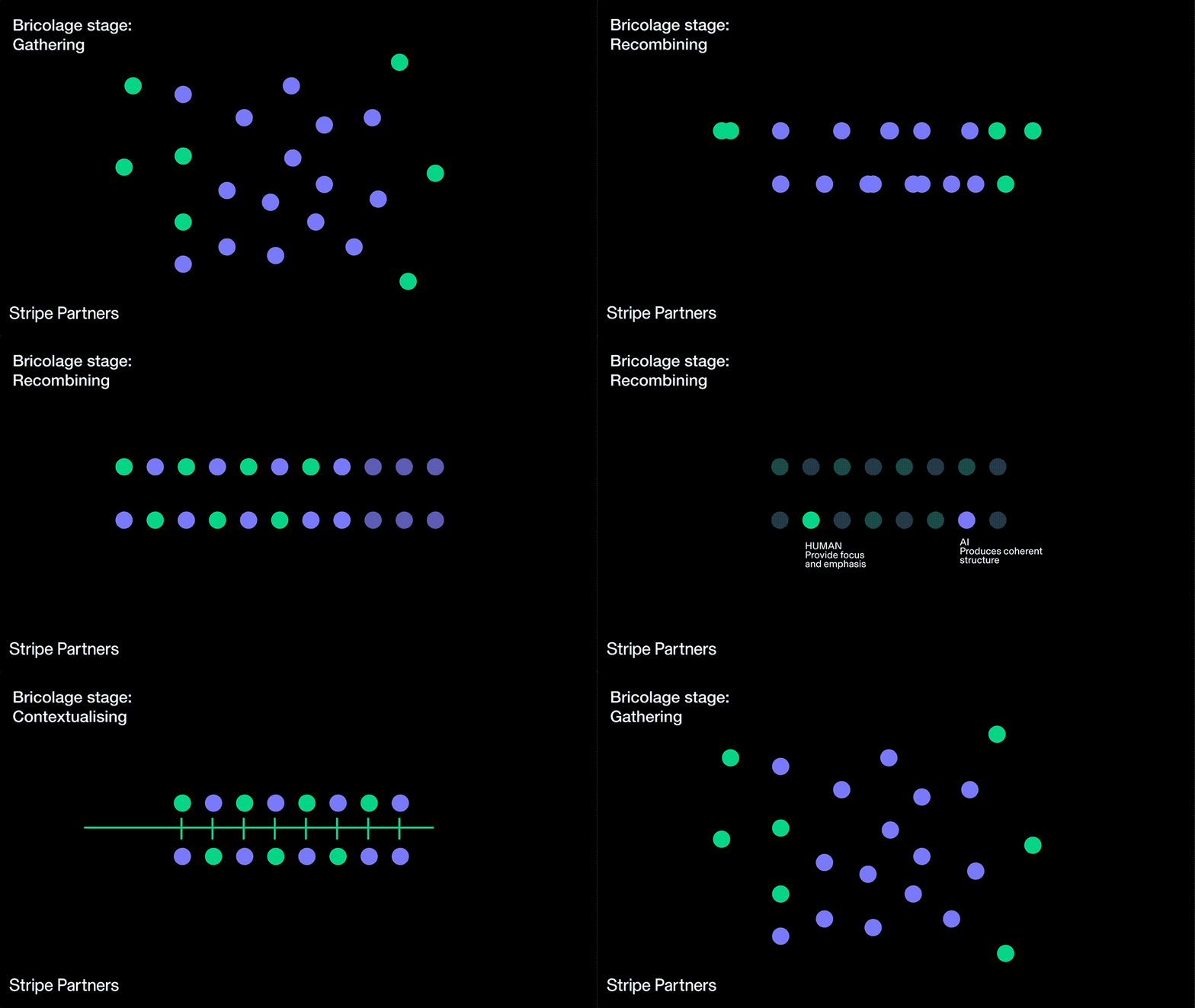
Gathering
The first stage concerns the identification of materials. In any given situation, a wide range of possible elements may be available: ideas, references, examples, and established forms. The act of gathering involves selecting from this field. It requires an assessment of relevance and an awareness of what is available but not immediately apparent. Different selections produce different possibilities for subsequent construction.Recombining
The second stage involves the arrangement of these materials. Recombination entails structuring, ordering, and relating elements to one another. It includes decisions about emphasis, sequence, and contrast. Similar materials may produce different effects depending on how they are combined. This stage establishes coherence, but also shapes the direction of interpretation.Contextualising
The third stage concerns the positioning of the resulting construction. Contextualisation involves situating the assembled materials within a specific setting. This includes considerations of audience, purpose, and moment. The same configuration of elements may be interpreted differently depending on how it is presented and where it is placed. Through this process, meaning becomes specific rather than general.
To see this in action, consider the process of cooking a meal at home without a fixed recipe. The first stage involves selecting which ingredients are appropriate, based on what is at hand and what is to be prepared. The second stage involves combining those ingredients—deciding on sequence, proportion, and method—in order to produce a coherent dish. The third stage concerns how the dish is presented and situated: how it is seasoned, plated, and served in relation to the occasion.
The same ingredients can produce markedly different outcomes depending on how these stages are handled. Variation does not depend solely on what is available, but on how those materials are selected, combined, and positioned.
In this sense, the process of bricolage provides a general model of construction. It becomes applicable to writing once style is recognised as one of the materials through which meaning is produced.
Written expression does not consist solely in the transmission of content. It involves the selection and deployment of stylistic forms: tones, registers, and conventions that are culturally available. From this perspective, style itself may be treated as a resource within the process of bricolage.
Applying the framework
Within the contemporary context of AI-assisted writing, the relevance of these stages becomes more apparent.
Generative systems are particularly effective at gathering and recombining but tend towards generality. If these outputs are adopted without further human intervention, the stages of bricolage are effectively compressed. Variation is reduced, and the resulting writing reflects a limited range of expression.
The role of the human, in this context, lies in exercising judgement at each stage of the process when working collaboratively with AI systems.
This distribution highlights the specific points at which human intervention is required.
In the stage of gathering, AI provides breadth, while human judgement determines relevance and introduces specificity, along with creative ideas that are not obvious—through whim, creative inspiration or serendipity. In recombination, AI produces coherence, while human judgement shapes form and emphasis. In contextualisation, AI provides articulation, while human judgement establishes voice and distinction.
Imagine a product leader—we’ll call them Leslie—preparing a vision document for their team. They begin by using an AI system to generate an initial set of ideas and examples. The output provides a broad and coherent overview, drawing on familiar patterns in product strategy.
Leslie evaluates the generated materials in relation to the organisation’s specific priorities and constraints. Certain elements are retained, others are discarded, and additional considerations are introduced.
The set of materials is thereby both narrowed and diversified.
The process then moves to recombination. The AI system organises the selected materials into a structured draft. While coherent, the result reflects a tendency towards balance and completeness. Leslie intervenes by adjusting emphasis and restructuring the argument to foreground a particular direction.
Finally, the question of expression is addressed. The draft is fluent but adopts a neutral tone. Leslie revises the language, adjusting tone and level of directness to convey a more specific voice.
Through this process, the roles of the human and AI become differentiated. One provides breadth, coherence, and fluency. The human determines relevance, emphasis, and voice. Distinctiveness emerges from these points of intervention.
Distinctive writing, under these conditions, is not a function of generation alone. It depends on how the process is managed, and on the points at which intervention occurs.
The task, therefore, is not to eliminate the use of AI, but to engage with it in a manner that preserves variation and specificity. This involves recognising where the system is most effective, and where its tendencies require adjustment. Through this balance, writing can remain both efficient and distinct.

Further reading
Here is a small selection of past Frames that provide other perspectives on the theme of exploring the ways people can work with AI.
“Why the debate about the future of AI needs less Darwin and more Latour“: In this Frame we explore alternative sociological frameworks to understand AI’s technological evolution and its complex interdependence with human infrastructure.
“Using Cognitive Apprenticeship to preserve human expertise amidst AI“: For this Frame, we took a longitudinal view, discussing how the craft of today’s knowledge workers can be preserved and passed on as AI tools become more prevalent.
“Building agency into the relationships between humans and AI”: Here we advocate for a more collaborative approach to human-algorithmic interactions that fosters greater experimentation, autonomy, and trust
“Igor Kopytoff and singularisation”: Here we explore how grounding algorithmic outputs in social and cultural contexts transforms them from generic commodities into uniquely meaningful experiences
Frames is a monthly newsletter that sheds light on the most important issues concerning business and technology.
Stripe Partners helps technology-led businesses invent better futures. To discuss how we can help you, get in touch.
